
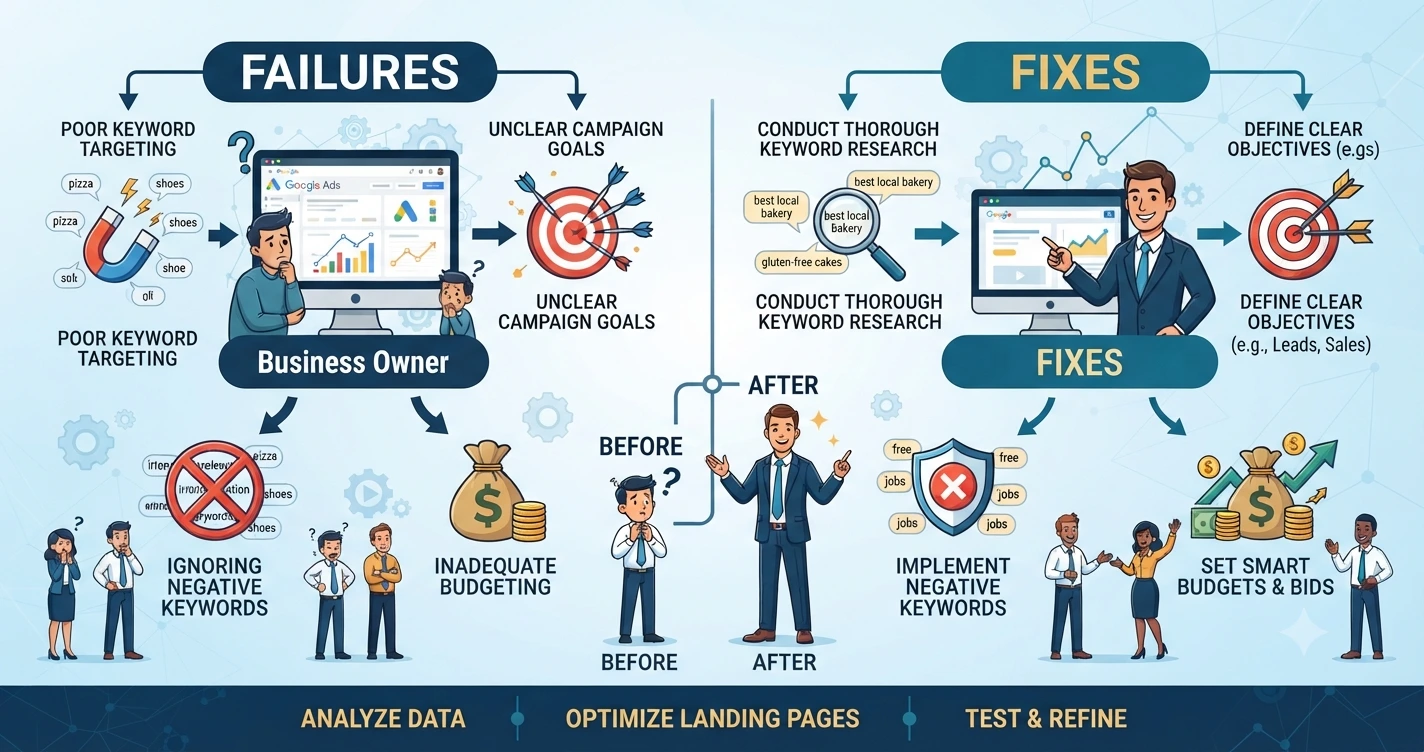
For small businesses and local brands across Mangalore and coastal Karnataka, Google Ads looks like the ultimate marketing solution. The promise is incredibly straightforward: you pay Google to display your website at the absolute top of search results the exact second a potential customer searches for your product or service.
Unlike traditional advertising channels like billboards or newspapers where you pay a flat fee regardless of results, Google operates on a Pay-Per-Click (PPC) model—meaning you only pay when someone actually clicks on your link.
Yet, despite this clear advantage, thousands of small business owners launch ad campaigns only to watch their marketing budget disappear within days without securing a single new customer. Frustrated, they conclude that digital advertising doesn't work for their industry.
The truth is, Google Ads works exceptionally well—but it is a highly technical platform that punishes unoptimized setups. Let’s look at the three primary reasons small businesses fail at Google Ads and exactly how you can fix them to maximize your return on investment.
1. Using Broad Match Keywords by Default
When you set up a basic campaign, Google nudges you to enter general keywords related to your business. By default, these keywords are configured as Broad Match. This is the single biggest budget leak for small business campaigns.
The Failure: Broad match tells Google’s algorithm to display your ad for any search query that is even vaguely related to your keyword, including synonyms, misspellings, and completely irrelevant phrases. For example, if a local bakery enters the broad match keyword Cake Shop, Google might display their ad to a user searching for Free wedding cake recipes online or How to bake a cake at home. The business pays for those clicks, but those users have zero intention of buying a product.
The Fix: Switch your targeting strategy to Phrase Match (enclosing keywords in quotation marks like "Cake Shop in Mangalore") or Exact Match (using brackets like [Order Birthday Cake Mangalore]). This forces Google to only display your ads when a user’s search query matches the specific intent of your product or service.
2. Neglecting the "Negative Keywords" List
Most business owners spend all their time deciding which search terms they want to rank for, completely forgetting to list the search terms they want to avoid.
The Failure: Without a robust Negative Keywords list, your ads will continuously trigger for low-intent or toxic search queries that drain your budget. If you are a premium software development firm or a private educational institute, you do not want your paid ads appearing when users type terms like Free, Cheap, Download crack, or Jobs.
The Fix: Before launching any campaign, build a comprehensive negative keyword list to block these terms. Once your campaign goes live, review your Search Terms Report every single week. Identify any irrelevant queries that triggered your ad and immediately add them to your negative keyword blocklist to stop further budget waste.
3. Directing Paid Traffic to an Unoptimized Homepage
Another common pitfall is spending weeks optimizing keywords and bidding strategies, only to direct every single click straight to your website’s generic homepage.
The Failure: A homepage usually contains general information—about pages, team photos, mission statements, and multiple navigating menus. When a user clicks an ad looking for a highly specific solution (such as Emergency Plumbing Service near me), landing on a generic homepage forces them to dig through menus to find what they need. If they don't find it within three seconds, they click the back button. You still pay for the click, but you lose the customer.
The Fix: Never send ad traffic to your homepage. Build dedicated, high-conversion Landing Pages tailored specifically to the exact ad the user clicked. If your ad promotes a specific 40% scholarship deal, the landing page must focus entirely on that scholarship, featuring a bold headline, a clear list of benefits, and a simple, unmissable contact form.
Master Digital Marketing with Zen Institute
Google Ads, Search Engine Optimization (SEO), and social media algorithms update constantly. Managing a profitable ad campaign requires deep, practical knowledge of analytics, consumer psychology, and digital funnels. Running campaigns based on guesswork is simply an expensive mistake.
At Zen Institute Mangalore, our professional Digital Marketing Course is built to turn you into a confident, data-driven marketing strategist.
Led step-by-step by elite corporate marketing directors currently managing major budgets for top brands, our practical curriculum drops boring theory to focus entirely on live campaign execution. You will gain hands-on experience setting up real Google Ads campaigns, mapping high-converting landing pages, mastering Meta ad networks, and analyzing live data dashboards.
Alongside your industry-recognized certification, every student receives comprehensive career and placement support—including portfolio design, resume optimization, mock client pitches, and direct interview referrals to our expanding network of local and national agency partners.
Stop guessing with your advertising budgets. Build the specialized digital skills that directly scale business revenue and open up high-paying corporate marketing roles.
Frequently Asked Questions (FAQs)
1. Why do small businesses fail with Google Ads?
Small businesses often struggle with Google Ads because they use broad match keywords, ignore negative keywords, and send visitors to generic homepages instead of dedicated landing pages, resulting in wasted ad spend and low conversions.
2. What are broad match keywords in Google Ads?
Broad match keywords allow Google to show your ads for a wide range of related searches, including irrelevant queries. Using phrase match or exact match keywords can help attract more qualified traffic.
3. What are negative keywords, and why are they important?
Negative keywords prevent your ads from appearing for irrelevant searches. Adding terms like "free," "jobs," or "download" can help reduce wasted clicks and improve your campaign's return on investment (ROI).
4. Why should I use a landing page instead of my homepage for Google Ads?
A dedicated landing page matches the intent of your ad, provides relevant information, and encourages visitors to take action, leading to higher conversion rates than sending traffic to a general homepage.
5. How can Zen Institute help you master Google Ads and digital marketing?
Zen Institute's Digital Marketing Course offers hands-on training in Google Ads, SEO, landing page optimization, Meta Ads, analytics, and campaign management, along with certification, resume building, mock interviews, and placement support.