The employment landscape in 2026 has fundamentally changed, leaving many traditional college graduates stranded. For decades, the standard path to a successful career followed a predictable formula: complete your 12th standard schooling, spend three to four years memorizing textbooks, earn a degree, and wait for corporate job offers to roll in.
Today, that formula is broken. With artificial intelligence automating basic administrative tasks and technology stacks updating in a matter of months, the global skills gap has reached an all-time high. When multinational companies (MNCs) recruit fresh talent in Mangalore, they no longer focus on the name of an applicant's university or their cumulative college grade point average.
Instead, hiring managers look for a definitive answer to one critical question: Can you step into this role and manage a live project on day one without hand-holding?
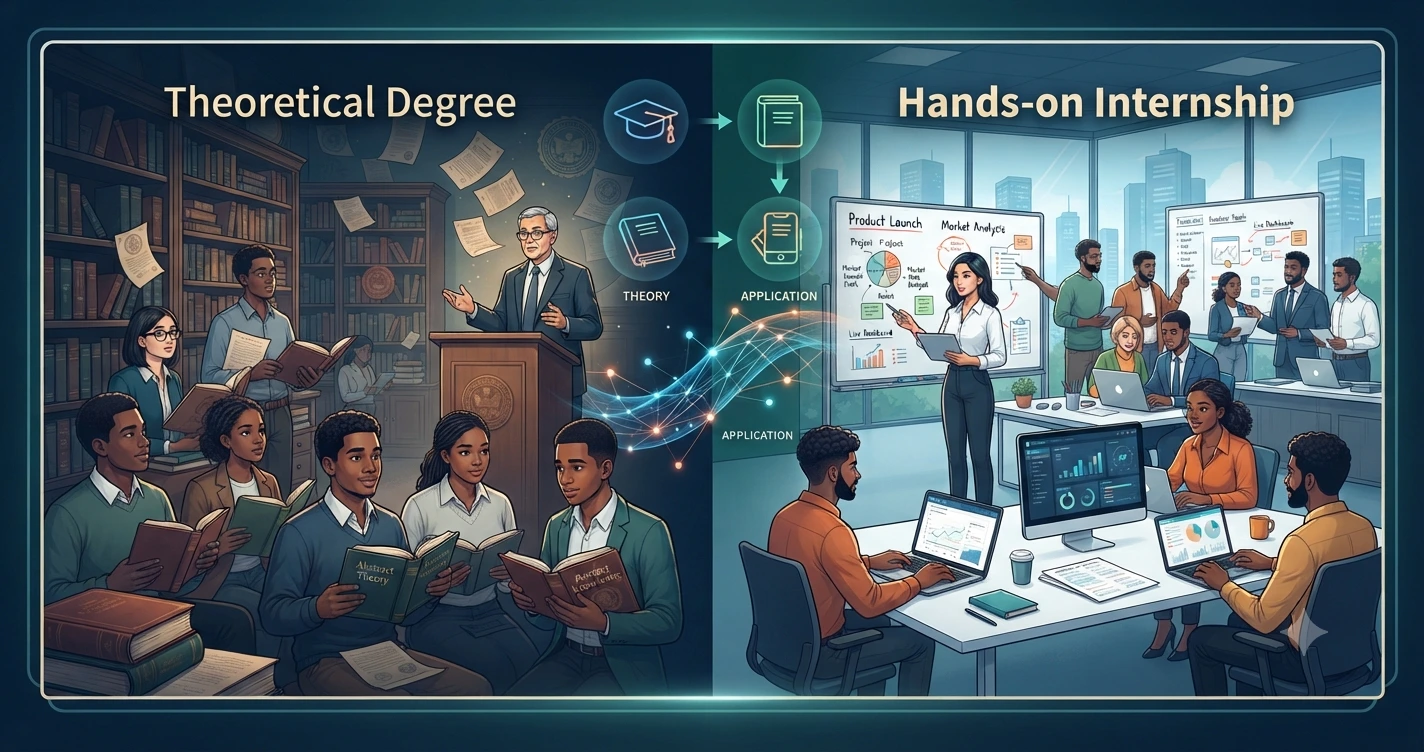
This shift explains why hands-on internship experience matters far more than traditional theoretical degrees. Let's look at why practical application has become the primary metric for modern employment.
1. Textbooks Cannot Keep Pace with Real-World Industry Tools
The primary limitation of traditional academic degrees is structural speed. University curricula go through a rigid, multi-year bureaucratic approval process before any new textbook or syllabus can be introduced to students.
In the modern technology sector, software platforms change rapidly. A textbook printed a couple of years ago cannot teach a student how to leverage live AI prompt workflows, navigate the latest dashboard updates in Power BI, or handle the recent security protocols in advanced Full-Stack Development.
When you learn exclusively through traditional academic classrooms, you memorize definitions. When you work through an immersive internship, you master the actual software tools, workflows, and cloud environments that companies use right now.
2. Overcoming the "No Experience, No Job" Paradox
Every fresh graduate faces a frustrating corporate paradox when entering the job market: You cannot get a job because you do not have work experience, but you cannot get work experience because no one will hire you without a job.
Traditional Degree Only Track: Resumes lack real-world projects, which traps you in an endless entry-level rejection loop.
Degree + Immersive Internship Track: Gives you verified portfolio proof that helps you bypass traditional experience requirements entirely.
An internship breaks this loop completely. It gives you immediate access to a professional environment where you can build verifiable case studies. When you can present an interviewer with a live portfolio—showing a website you personally deployed, a database you optimized using SQL, or a local brand's revenue you increased through performance marketing—you bypass standard entry-level requirements. Your portfolio serves as proof of capability, making your age or graduation major secondary.
3. Developing Critical Corporate Soft Skills
Technical ability is only half the battle when trying to secure a long-term corporate role. You cannot learn workplace dynamics, emotional intelligence, or professional communication from a classroom lecture.
Immersive internships place you directly inside the corporate ecosystem, teaching you how to:
Present data insights clearly to corporate management.
Collaborate across multi-disciplinary teams using remote project management software like Slack or Jira.
Handle high-pressure deployment deadlines and real-time client feedback constructively.
These interpersonal skills differentiate a junior technician from a true professional, making you an asset to any hiring team.
Secure Your Placement with Zen Institute’s Combined Scholarship & Internship Tracks
Understanding that practical application is the key to employment, the team at Zen Institute Mangalore has structured our entire training model around real-world execution. We move past boring rote learning to focus exclusively on project-driven curricula designed and led by elite mentors currently working at top MNCs.
To help local students kickstart their tech journeys, Zen Institute is offering up to 40% scholarships on specialized skill courses that come integrated with practical internships.
Up to 40% Scholarships are available for eligible students.
Includes completely hands-on training with industry-standard tools.
Combined with guaranteed placement support, professional resume design, and mock interviews.
Limited intake: Only 25 seats are available per batch to ensure individual attention.
Our students don't just study data analytics, software development, graphic design, or digital marketing—they actively practice those skill sets on live institutional accounts and corporate projects. This practical immersion is why our programs maintain a 95% success rate in job placements, helping students launch successful corporate careers within weeks of finishing their tracks.
Stop waiting for a traditional degree to magically open doors. Build your technical skill set, gain real internship experience, and secure a stable career path in today's digital economy.
Frequently Asked Questions (FAQs)
1. Why are internships important for students and fresh graduates?
Internships provide practical experience, help you apply classroom knowledge to real-world projects, develop professional skills, and strengthen your resume, making you more competitive in the job market.
2. Do employers value internships more than academic degrees?
Most employers value both, but practical experience gained through internships often gives candidates an advantage because it demonstrates job readiness and hands-on skills.
3. Can I get a job without internship experience?
Yes, but having internship experience can significantly improve your chances of getting shortlisted, performing well in interviews, and securing entry-level roles, especially in competitive industries.
4. What skills can I develop during an internship?
Internships help you build technical skills, communication, teamwork, problem-solving, time management, and professional workplace experience that employers value.
5. How do internships improve career opportunities?
Internships allow you to gain industry exposure, build a professional portfolio, expand your network, and develop practical experience, which can lead to better job opportunities after graduation.