If you have been browsing job portals or looking into technology courses in Mangalore, you have likely run into the phrase Full-Stack Web Development. It is one of the most in-demand job profiles in the modern software industry, with companies actively competing to hire skilled developers.
However, to someone just starting out, the technical jargon can feel overwhelming. Terms like "frontend," "backend," "databases," and "APIs" are thrown around constantly without much explanation.
What does a full-stack developer actually do? To understand it clearly, we don't need complex computer science definitions. Let's look at it using a simple analogy: running a successful restaurant.
The Restaurant Analogy of Web Development
Think of a website or a web application (like Amazon, Netflix, or your online banking portal) exactly like a busy restaurant. To serve customers, a restaurant needs three distinct components to work together seamlessly:
1. The Frontend (The Dining Area)
The frontend is the dining room of the restaurant. It is everything the customer sees, touches, and experiences directly. This includes the beautifully set tables, the lighting, the physical menus, and the waiters who take your order.
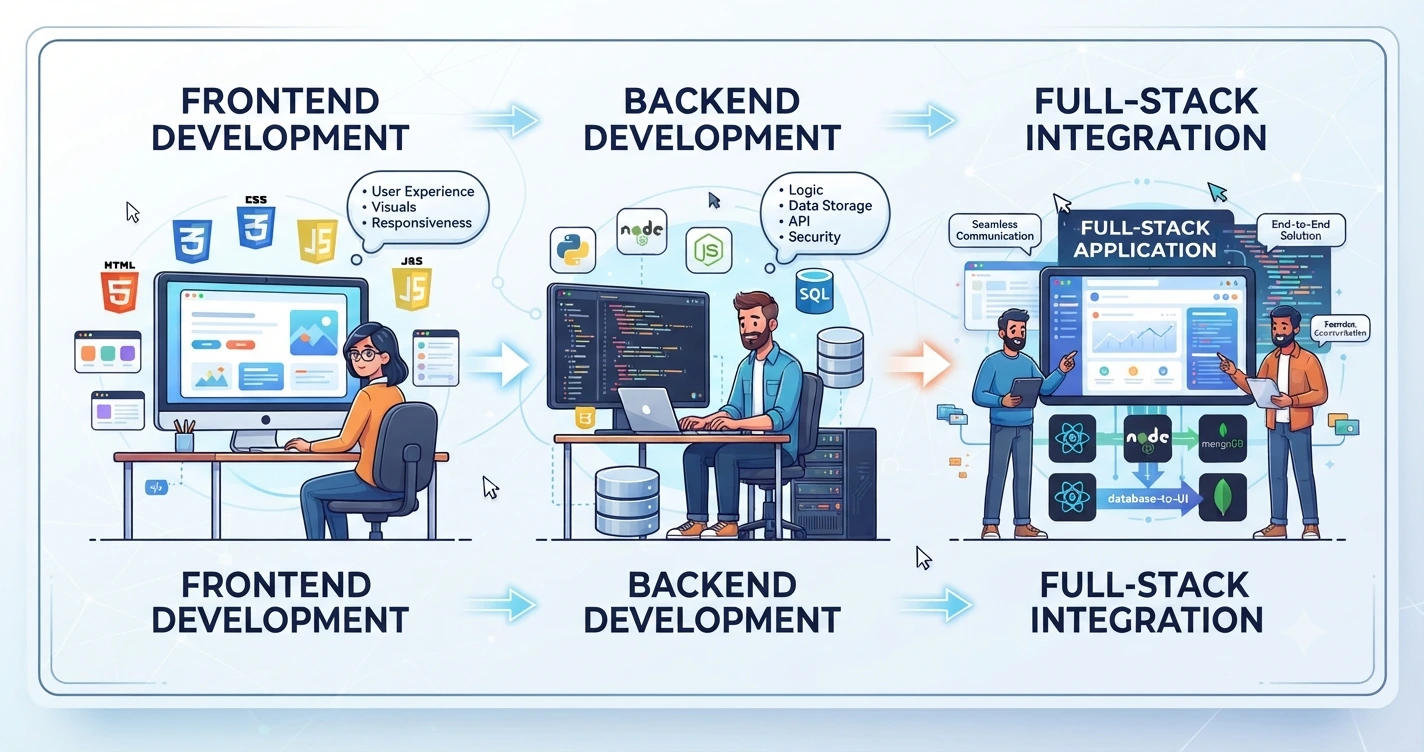
In Web Development: The frontend is the user interface. It is the visual part of the website that loads on your phone or laptop screen. Every button you click, the colors, the fonts, the layout of the images, and the text you read are built by frontend developers.
The Core Tools: HTML (the structural skeleton), CSS (the design, colors, and layout), and JavaScript (the interactive elements, like pop-up menus and animations).
2. The Backend (The Kitchen)
The backend is the restaurant's kitchen. It is completely hidden from the customer's view, but it is where the actual work happens. When a waiter takes your order and walks through the kitchen doors, the chefs get to work preparing your food based on strict recipes.
In Web Development: The backend is the server-side architecture. When you click "Buy Now" on an e-commerce site, your screen doesn't magically process your credit card. A request is sent to a hidden server (the kitchen) where backend code verifies your payment, updates the seller, and processes the transaction securely.
The Core Tools: Programming languages and frameworks like Python, Node.js, PHP, or Ruby.
3. The Database (The Pantry)
The pantry is where the restaurant stores all its raw ingredients, spices, and recipes. The chefs in the kitchen constantly access the pantry to grab what they need to prepare your meal.
In Web Development: The database is where all user information is stored securely. When you log into Netflix, the system needs to check if your password is correct and remember which movies are on your watchlist. All of this user data is organized inside a database.
The Core Tools: SQL (Structured Query Language), PostgreSQL, or MongoDB.
What Does a "Full-Stack" Developer Do?
A Frontend Developer only designs the dining room. A Backend Developer only manages the kitchen.
A Full-Stack Developer is a highly versatile engineer who can manage both. They understand how to design a beautiful visual interface (frontend), write the complex server logic to make it work (backend), and organize the information cleanly inside a database.
Because they understand the entire pipeline, they can build complete, working web applications from scratch on their own.
Why are Full-Stack Developers Highly Valued?
Modern tech startups, local agencies, and global MNCs prefer hiring full-stack developers for three major reasons:
Versatility: They can easily switch between different types of tasks depending on what a project needs at any given moment.
Better Communication: Since they understand both sides of development, they bridge the communication gap between designers and engineers.
Cost-Efficiency: For early-stage companies and startups, hiring one full-stack developer is much more cost-effective than hiring separate frontend and backend specialists.
Master Full-Stack Development with Zen Institute
You don't need a formal computer science degree to become a professional web developer. What you actually need is a structured, hands-on understanding of how these three components connect to build live applications.
At Zen Institute Mangalore, our comprehensive Full-Stack Web Development Course is designed to take you from absolute beginner to industry-ready engineer.
Taught entirely by elite mentors currently leading software teams at top global MNCs, our curriculum focuses on building real, production-ready projects. You will master frontend tools like HTML, CSS, React, and Tailwind, build robust servers using Node.js, and design secure databases using SQL.
Alongside your industry-recognized certification, you will receive complete, dedicated career assistance—including portfolio creation, professional resume design, and direct job referrals to our local and national hiring partners.
Frequently Asked Questions (FAQs)
1. What is Full-Stack Web Development?
Full-Stack Web Development involves building both the frontend (what users see and interact with) and the backend (server-side logic and databases) of a website or web application. A full-stack developer can create complete web applications from start to finish.
2. Do I need prior coding knowledge to learn Full-Stack Web Development?
No. Most Full-Stack Web Development courses are designed for beginners. You can start without any programming experience and gradually learn HTML, CSS, JavaScript, backend development, databases, and modern frameworks through hands-on practice.
3. Which skills are required to become a Full-Stack Developer?
The essential skills include HTML, CSS, JavaScript, React, Node.js, SQL or MongoDB, Git, APIs, and responsive web design. Learning these technologies helps you build complete, real-world web applications.
4. What career opportunities are available after learning Full-Stack Web Development?
After completing a Full-Stack Web Development course, you can pursue roles such as Full-Stack Developer, Frontend Developer, Backend Developer, Web Developer, Software Engineer, JavaScript Developer, or UI Developer across startups, IT companies, and MNCs.
5. Why should I learn Full-Stack Web Development at Zen Institute Mangalore?
Zen Institute Mangalore offers a practical, project-based Full-Stack Web Development Course led by experienced industry mentors. Students gain hands-on experience with real-world projects, earn an industry-recognized certification, and receive career support through portfolio development, resume building, mock interviews, and placement assistance.