
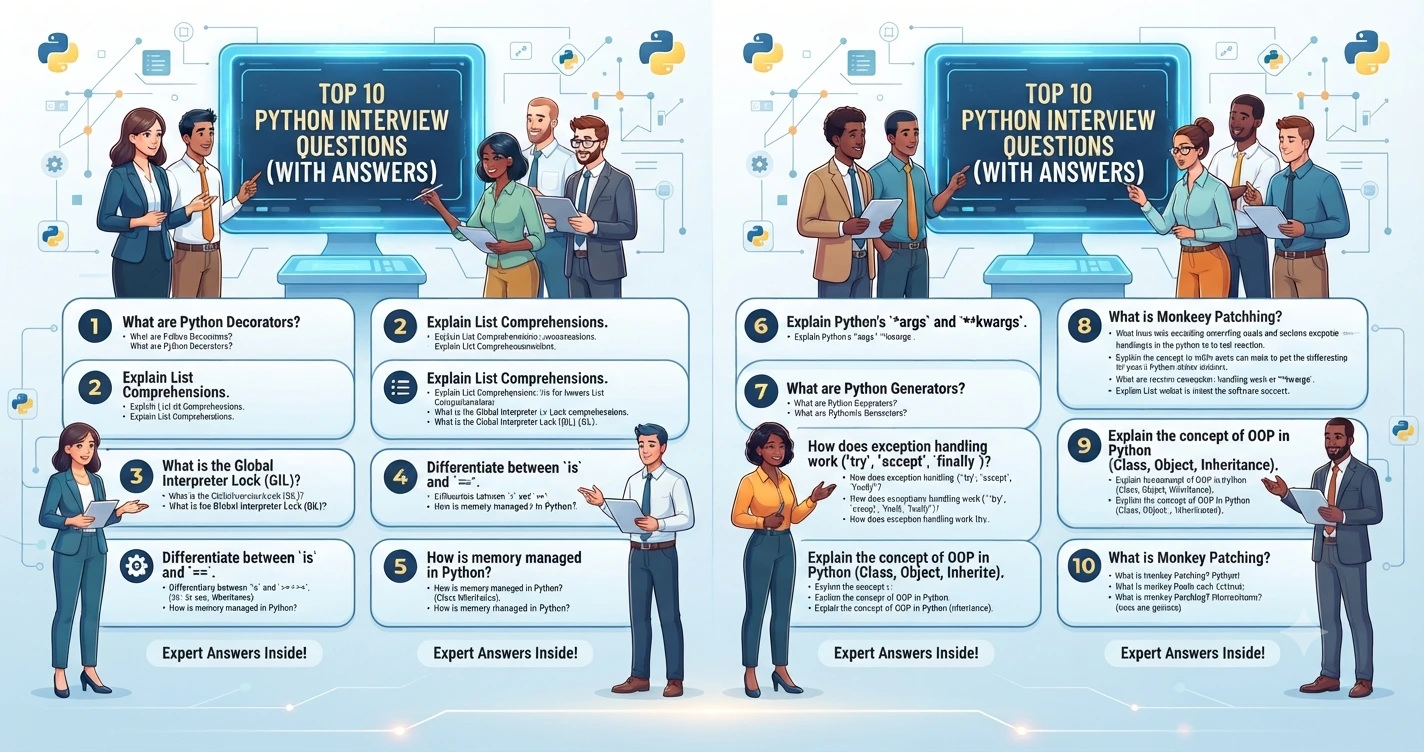
Python has become the undisputed language of choice for modern technology architectures. Whether you are aiming for a career in Data Science, Artificial Intelligence, Web Development, or Test Automation, coding proficiency in Python is highly sought after by top multinational companies (MNCs).
However, passing a technical interview at an MNC requires more than just knowing how to write basic syntax. Interviewers look for a deep understanding of core concepts, memory management, and clean coding practices.
If you are preparing for technical interview rounds in Mangalore, reviewing these top 10 commonly asked Python interview questions will help you understand what major employers expect.
1. What is the difference between a List and a Tuple in Python?
This is a fundamental question used to test your understanding of data structures and memory management.
Answer: The primary difference is mutability. Lists are mutable, meaning you can modify, add, or remove elements after creation. Tuples are immutable; once defined, their elements cannot be changed.
Technical Context: Lists are declared using square brackets [], while tuples use parentheses (). Because tuples are immutable, they are stored in a single block of memory, making them faster to iterate through and more memory-efficient than lists.
2. How is memory managed in Python?
MNC interviewers want to know if you understand what happens behind the scenes when your code executes.
Answer: Memory management in Python is handled automatically by the Python Memory Manager through a private heap space. All objects and data structures reside here, and developers cannot access this private heap directly.
Key Concept: Python uses two primary mechanisms to clear memory: Reference Counting (tracking how many references point to an object) and an automatic Garbage Collector (which detects and deletes cyclical, unused memory blocks to prevent memory leaks).
3. What are Python Decorators, and when would you use them?
This question evaluates your familiarity with advanced object-oriented programming patterns.
Answer: A decorator is a structural design pattern that allows you to modify or extend the behavior of a function or class without permanently changing its source code. Decorators wrap another function to dynamically alter its execution.
Example Use Case: They are widely used for logging user actions, checking authorization/permissions in web applications, or measuring the execution runtime of specific functions.
4. Explain the difference between Deep Copy and Shallow Copy.
This question checks if you understand how Python handles object references in memory.
Answer:
A Shallow Copy creates a new object container, but copies the references of the child objects into it. If you modify a nested object in the original list, the change will reflect in the shallow copy.
A Deep Copy creates a new object container and recursively copies all child objects dynamically. The two objects become completely independent in memory.
5. What is the purpose of __init__ in Python classes?
This tests your foundational knowledge of Object-Oriented Programming (OOP) principles.
Answer: The __init__ method is a reserved method in Python classes, widely known as a constructor. It runs automatically whenever a new object (instance) of a class is created. Its primary purpose is to initialize the object's attributes and allocate necessary resources.
6. What are Generators in Python, and how do they save memory?
Understanding performance scaling is essential for handling large-scale data applications.
Answer: A generator is a specialized function that returns an iterable collection of items one at a time, utilizing the yield keyword instead of return.
Why it saves memory: Traditional functions calculate an entire list and store it completely in your RAM before returning it. Generators compute values on-the-fly (lazy evaluation) and pause execution after yielding a value, making them ideal for processing massive data streams without crashing your system.
7. How does Python handle Multiple Inheritance?
This question looks at how Python resolves structural conflicts between parental classes.
Answer: Python supports multiple inheritance, allowing a child class to inherit attributes and methods from more than one parent class. To avoid conflicts (known as the Diamond Problem), Python uses a strict algorithm called MRO (Method Resolution Order). It defines a clear left-to-right, depth-first hierarchy to determine exactly which parent method executes first.
8. What is the difference between remove(), del, and pop() in lists?
Interviewers use this to see if you pay attention to return values and index management.
Answer:
remove() deletes the first occurrence of a matching value from the list (raises a ValueError if the item isn't found). It does not return the deleted value.
pop() removes and returns an element at a specific index. If no index is provided, it removes the last item.
del is a built-in keyword that deletes an element at a specific index or slices out an entire section of a list without returning anything.
9. What are Lambda functions, and why are they called anonymous?
Testing your ability to write concise, functional code blocks.
Answer: A Lambda function is a small, single-expression function defined without a standard name using the lambda keyword. They are called anonymous because they don't require the traditional def declaration format. They are typically used for short, one-time operations alongside functions like map(), filter(), and reduce().
10. What is the purpose of *args and kwargs in function arguments?
This checks your comfort level with designing flexible, dynamic software codebases.
Answer:
*args allows a function to accept any number of positional arguments passed as a tuple.
kwargs allows a function to accept an arbitrary number of keyworded (named) arguments passed as a dictionary.
Value: They allow developers to write flexible functions that can handle varying inputs without manually defining every parameter ahead of time.
Master Tech Interviews with Zen Institute
Knowing the answers to theoretical questions is a great start, but passing a high-level MNC interview requires hands-on execution. Top software firms don't just ask definitions—they give you complex coding challenges, architecture design tasks, and live debugging tests.
At Zen Institute Mangalore, our Python Programming Track and advanced tech modules are designed to bridge this practical gap. Taught entirely by expert mentors who work at leading MNCs, our programs move away from rote learning to focus on live project builds, algorithm optimization, and clean architecture paradigms.
Every student goes through comprehensive placement preparation—including technical mock interviews, interactive problem-solving code sessions, and professional profile reviews to ensure your skills translate directly into career opportunities.
Take the guesswork out of your technical preparation. Learn the skills and patterns that global employers demand.
Frequently Asked Questions (FAQs)
1. Is Python enough to get a job in an MNC?
Python is a highly in-demand programming language, but employers also look for problem-solving skills, data structures, object-oriented programming (OOP), SQL, and hands-on project experience during technical interviews.
2. How should beginners prepare for Python interviews?
Start by learning Python fundamentals, practice coding regularly, understand OOP concepts, solve programming problems, and work on real-world projects to build confidence for technical interviews.
3. What types of Python interview questions do companies ask?
Technical interviews typically include questions on Python basics, data structures, OOP, memory management, functions, exception handling, file handling, and coding challenges that test problem-solving abilities.
4. Do I need projects on my resume for a Python developer role?
Yes. Personal or academic projects demonstrate your practical coding skills and help recruiters evaluate your ability to apply Python concepts in real-world scenarios.
5. Which careers can I pursue after learning Python?
Python opens opportunities in Software Development, Data Science, Artificial Intelligence, Machine Learning, Web Development, Test Automation, Data Analytics, and Backend Development.