When people talk about building a safe, professional, and equitable corporate culture, one legal and operational framework stands out above the rest in India: the POSH Act (Prevention of Sexual Harassment of Women at Workplace Act). Under this law, safeguarding employees isn't just an ethical duty—it is a strict statutory requirement for every registered business.
For any company employing ten or more individuals, the law mandates the creation of a specialized, highly independent body known as the Internal Committee (IC).
The IC is not just another standard HR sub-department. It is an independent administrative body that holds significant legal authority. Let’s look into the structural role, composition, and responsibilities of the Internal Committee in modern corporate governance.
1. The Legal Composition of the Internal Committee
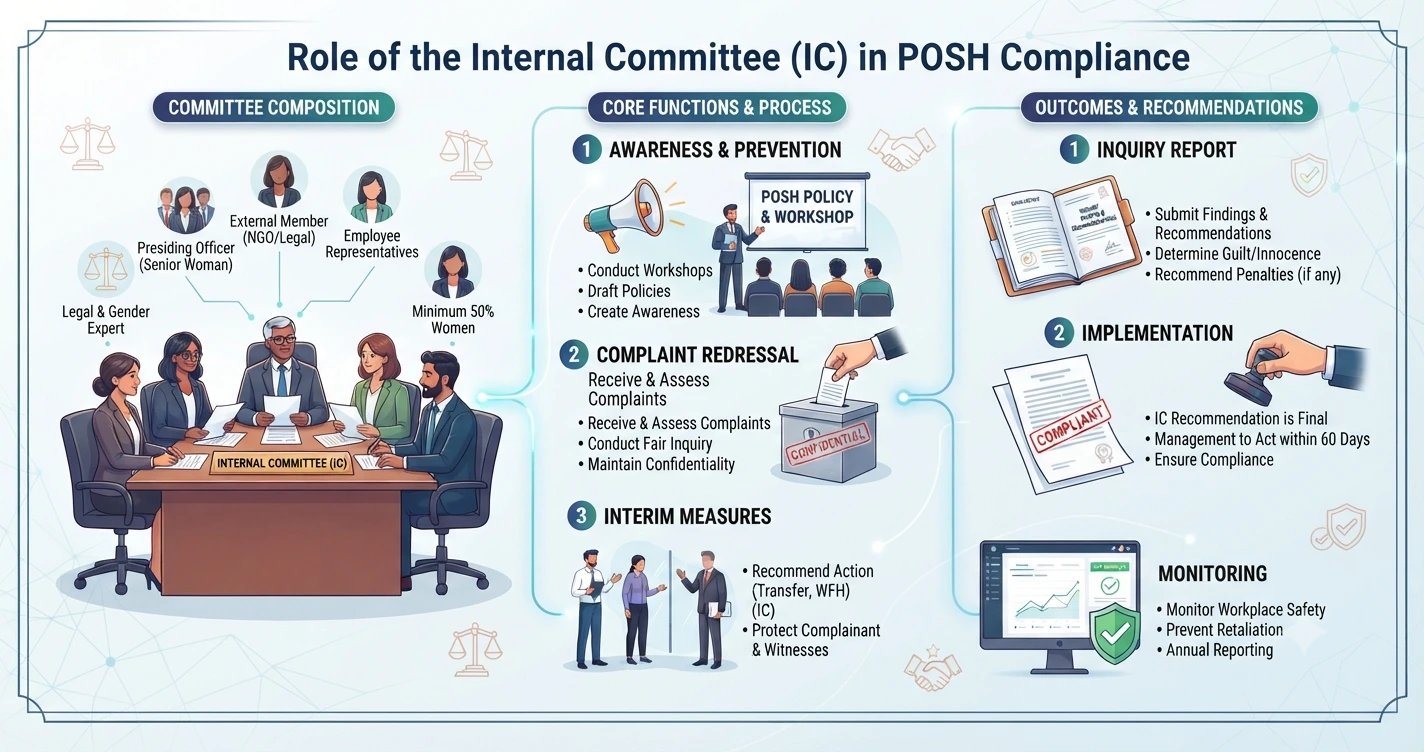
The law does not allow companies to arbitrarily pick a few managers to handle workplace complaints. The POSH Act defines a strict structural hierarchy for the constitution of an IC to ensure absolute fairness and transparency:
The Presiding Officer: Must be a woman employed at a senior level within the organization. This ensures leadership accountability and provides a comfortable reporting environment.
Employee Members: At least two employees who are preferably committed to the cause of women’s rights, possess legal background knowledge, or have experience in social work.
The External Member: This is a mandatory requirement. The company must recruit an outside specialist—such as a lawyer, an NGO representative, or a certified POSH compliance consultant. The external member acts as an objective third party, preventing internal corporate politics or management bias from influencing the committee's decisions.
Crucial Rule: The POSH Act explicitly states that at least 50% of the total members sitting on the Internal Committee must be women.
2. Executive Powers and Investigative Responsibilities
The Internal Committee acts as a neutral administrative body. When a complaint is filed, the law grants the IC the exact same powers as a Civil Court under the Code of Civil Procedure. This includes the legal authority to:
Summon and enforce the attendance of any individual for questioning.
Mandate the discovery and production of physical or digital evidence (such as emails, text messages, CCTV footage, or visitor logs).
Administer oaths and record official, legally binding statements.
The IC is responsible for handling the entire resolution lifecycle—from initiating confidential conciliation steps if requested by the complainant, to conducting formal inquiries, documenting testimonies, and delivering a final recommendation report directly to corporate management.
3. Protecting Workplace Confidentiality
The absolute backbone of an effective POSH framework is strict confidentiality. The IC is legally bound to protect the identities of the complainant, the respondent, and all witnesses involved in an inquiry.
Under Section 16 of the POSH Act, details regarding the complaint, the identities of the individuals, or the inquiry proceedings cannot be published, communicated, or disclosed to the public or the media. Any member of the committee or management who breaches this confidentiality rule faces immediate financial penalties and corporate disciplinary action.
Build Your Career in Corporate HR with Zen Institute
As corporate enforcement becomes stricter across India, businesses in Mangalore, Bangalore, and beyond are actively seeking certified professionals who understand corporate governance, compliance frameworks, and workplace legalities. HR is no longer just about conducting interviews—it is about managing risk and protecting organizational integrity.
At Zen Institute Mangalore, our comprehensive HR Management Course includes specialized training modules on corporate compliance, labor laws, and POSH Act frameworks.
Led entirely by elite corporate HR directors and legal consultants currently working with major MNCs, our program prepares you to navigate complex workplace scenarios, manage compliance audits, and structure legal committees effectively.
Alongside your industry-recognized certification, every student receives deep, personalized career support—including professional resume optimization, mock interview simulations, and direct placement support within our extensive corporate hiring network.
Stop limiting your administrative potential. Build the highly specialized legal and corporate skills that modern employers actively seek.
Frequently Asked Questions (FAQs)
1. What is an Internal Committee (IC) under the POSH Act?
An Internal Committee (IC) is a legally mandated committee that every organization in India with 10 or more employees must establish under the POSH Act, 2013. It is responsible for preventing, addressing, and resolving complaints of sexual harassment in the workplace.
2. Who should be a part of the Internal Committee?
The Internal Committee must include a Presiding Officer (a senior woman employee), at least two employee members, and one external member with experience in women's rights, legal matters, or social work. At least 50% of the committee members must be women, as required by the POSH Act.
3. What are the responsibilities of the Internal Committee?
The IC receives and investigates complaints of workplace sexual harassment, conducts fair and confidential inquiries, recommends appropriate actions, promotes awareness of the POSH Act, and helps organizations maintain a safe and respectful work environment.
4. Why is confidentiality important during a POSH inquiry?
Confidentiality protects the privacy of the complainant, respondent, and witnesses while ensuring a fair investigation. Under the POSH Act, disclosing details of a complaint or inquiry without authorization is prohibited and may result in legal and disciplinary action.
5. Why should I learn HR Management with POSH compliance at Zen Institute Mangalore?
Zen Institute Mangalore offers practical HR Management training that includes labor laws, corporate compliance, and POSH Act frameworks. Students learn from experienced HR professionals and legal experts while gaining industry-recognized certification, hands-on training, resume building, mock interviews, and placement assistance.