
When people think about the role of Human Resources (HR) in a corporate office, they often picture recruitment drives, onboarding games, or workplace culture events. While these employee engagement activities are important, they represent only the visible surface of a much deeper professional domain.
The true baseline of any successful HR department is Statutory Compliance.
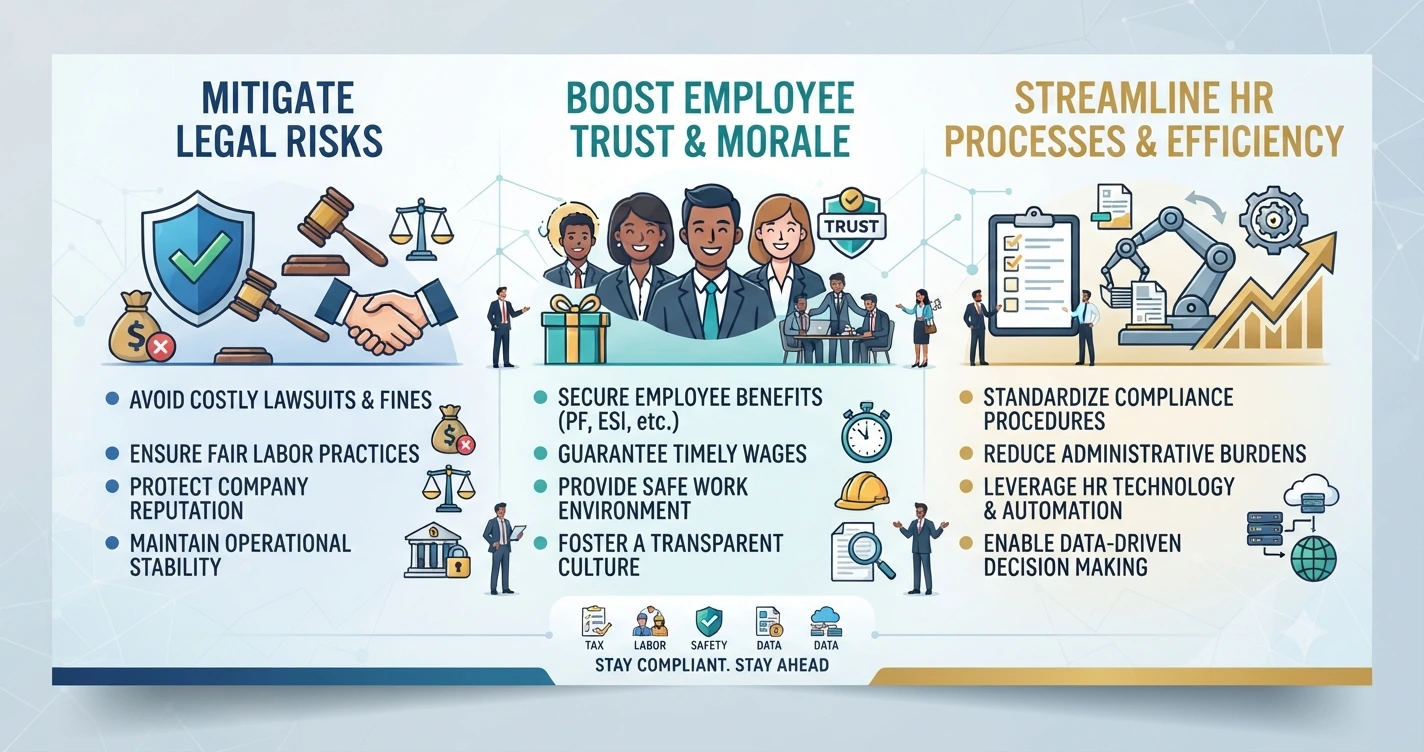
Statutory compliance refers to the strict legal framework within which an organization must operate, governed by state and federal labor laws. In India, managing a workforce involves navigating a complex web of legislation designed to protect both the employee and the employer. For corporate houses, tech firms, and businesses operating in Mangalore, non-compliance isn't just an administrative oversight—it is a legal risk that can lead to severe financial penalties, lawsuits, and permanent damage to a company's brand reputation.
1. Navigating Key Labor Laws and Employee Benefits
A certified HR professional must ensure that every corporate policy, salary structure, and operational workflow aligns seamlessly with statutory acts. In India, this requires managing several core legal frameworks:
The Employees' Provident Fund (EPF) Act: Mandates that a fixed percentage of an employee's salary be deducted and matched by the employer toward their long-term retirement savings.
The Employees' State Insurance (ESI) Act: Provides critical medical and socio-economic protection to employees earning below a specific wage slab, ensuring access to healthcare and sickness benefits.
The Payment of Bonus Act and Gratuity Act: Governs the statutory distribution of annual bonuses and defines long-term financial rewards for employees who complete five or more consecutive years of service with an organization.
The Minimum Wages Act: Ensures that no worker is exploited by establishing mandatory baseline payment thresholds across specialized and unspecialized corporate sectors.
2. Protecting the Organization from Harsh Legal Liabilities
When a company skips compliance tracking, it leaves itself open to regulatory penalties. Government labor inspectors conduct regular, unannounced audits of corporate payroll files, attendance logs, and workplace safety data.
If an organization fails to maintain accurate registers, mishandles provident fund deposits, or violates overtime working hours, the consequences are immediate. The company faces heavy interest penalties on unpaid dues, structural blacklisting from government contracts, and potentially even criminal litigation against corporate directors. A well-trained HR manager acts as the first line of defense, conducting regular internal audits to catch and fix compliance gaps before external regulators intervene.
3. Enhancing Brand Trust and Attracting Top Talent
Beyond the legal obligations, strict statutory compliance directly influences a business's reputation in the hiring market. In today's digital economy, candidates research company cultures on platforms like Glassdoor and LinkedIn before accepting a job offer.
When an organization gains a reputation for delayed EPF transfers, inconsistent salary payouts, or non-transparent tax deductions, its ability to recruit top-tier technical talent plummets. Conversely, displaying absolute transparency in statutory filings proves to prospective applicants that the organization is financially stable, secure, and respectful of its workforce's legal rights.
Build Your Career in Corporate HR with Zen Institute
As corporate enforcement becomes stricter across Karnataka and India, companies are aggressively moving away from traditional, entry-level admin clerks. Employers are actively hunting for modern HR strategists who understand corporate governance, employment law, and compliance management.
At Zen Institute Mangalore, our professional HR Management Course is designed to transform you into an invaluable corporate asset.
Led step-by-step by elite HR directors currently leading compliance teams at major multinational companies (MNCs), our practical curriculum goes far beyond theory. You will gain hands-on experience calculating real corporate payroll variables, navigating live government compliance portals, managing PF/ESI document trails, and structuring workplace safety frameworks like the POSH Act.
Alongside your recognized industry certification, every student receives comprehensive career and placement assistance—including professional resume optimization, mock corporate interview drills, and direct hiring referrals to our extensive network of local and national corporate partners.
Stop treating HR like a basic administrative role. Build the high-value compliance and management skills that command respect and premium salaries in today's corporate job market.
Frequently Asked Questions (FAQs)
1. What is statutory compliance in HR?
Statutory compliance in HR refers to following all labor laws and government regulations related to employee wages, benefits, workplace safety, taxation, and employment practices to ensure legal and ethical business operations.
2. Why is statutory compliance important for organizations?
Statutory compliance helps organizations avoid legal penalties, maintain accurate employee records, protect employee rights, and build a trustworthy reputation with employees, customers, and regulatory authorities.
3. What are the major labor laws every HR professional should know?
Key labor laws include the Employees' Provident Fund (EPF) Act, Employees' State Insurance (ESI) Act, Payment of Bonus Act, Payment of Gratuity Act, Minimum Wages Act, and the POSH Act.
4. What happens if a company fails to comply with labor laws?
Non-compliance can result in financial penalties, legal action, failed government audits, reputational damage, and loss of employee trust, making it difficult for businesses to attract and retain talent.
5. How can Zen Institute help you build a career in HR compliance?
Zen Institute's HR Management Course provides practical training in labor laws, payroll, statutory compliance, EPF, ESI, POSH, and HR operations, along with certification, resume building, mock interviews, and placement support.