
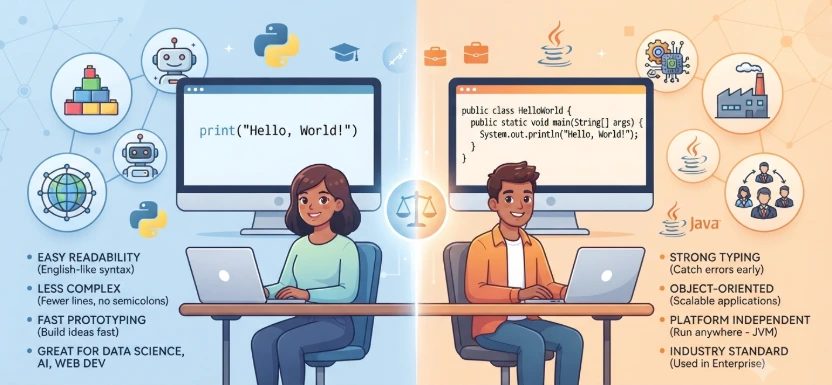
If you are taking your first steps toward a career in software development, data science, or web engineering, you will inevitably face a classic technical dilemma: Should you learn Python or Java first?
Both languages are absolute titans in the global tech ecosystem. They power everything from massive enterprise banking backends to state-of-the-art artificial intelligence models. Because they are both widely used by multinational companies (MNCs) and startups in Mangalore, mastering either one can lead to excellent career opportunities.
However, as a complete beginner, your choice matters. Picking a language that aligns with your learning style and career goals can mean the difference between landing a tech job or giving up out of frustration. Let’s look at how they compare across readability, learning curve, and career paths.
1. Syntax and Readability: Simple English vs. Strict Boilerplate
The most immediate difference you will notice when writing your first line of code is how the two languages handle syntax (formatting rules).
Python: Built with a philosophy focused on readability. It strips away visual clutter like semicolons and curly braces, using clean indentation instead. It reads almost like plain, logical English.
Java: A highly structured, statically typed language. It requires you to write explicit setup code—known as boilerplate—before you can execute even basic tasks.
Look at how much code it takes to print a simple line of text in each language:
Python Approach
print("Welcome to Tech")
Java Approach
public class Main {
public static void main(String[] args) {
System.out.println("Welcome to Tech");
}
}
For beginners, Python’s minimal syntax lowers the learning curve, allowing you to focus entirely on learning core programming logic rather than getting tripped up by missing semicolons.
2. Speed and Performance: Execution Efficiency
Behind the scenes, the two languages process instructions differently, impacting their speed:
Java's Performance Advantage: Java is a compiled language. The system converts the code into machine-readable bytecode before running it, making Java incredibly fast and efficient for handling high-volume transactions or complex enterprise software.
Python's Performance Trade-off: Python is an interpreted language, meaning the system reads and runs the code line-by-line at runtime. While this makes debugging easier, it makes Python structurally slower than Java. However, for 95% of modern business applications, this minor speed difference is negligible.
3. Career Paths: Choosing Your Technical Domain
Because these languages have different strengths, they dominate entirely different sectors of the technology market:
Feature | Python | Java |
Primary Core Fields | Data Science, Artificial Intelligence, Machine Learning, Automation, Web Backends | Enterprise Applications, Android App Development, Cloud Architecture, Legacy Systems |
Popular Frameworks | Django, Flask, Pandas, TensorFlow | Spring Boot, Hibernate, Android SDK |
Industry Standing | The undisputed king of AI and big data analytics | The foundational backbone of corporate banking and large-scale systems |
The Verdict: Which One Should You Pick?
Choose Python if you want an accessible learning curve, enjoy working with data, or want to break into high-paying, cutting-edge fields like Artificial Intelligence, Data Science, and rapid web prototyping.
Choose Java if you want to build a deep, foundational understanding of classical computer science architecture, aim to specialize in Android mobile application development, or want a long-term career maintaining large-scale infrastructure for massive financial MNCs.
Launch Your Programming Journey with Zen Institute
Reading about code won't make you a developer—writing code will. No matter which language fits your career goals, the key to success is receiving structured, hands-on guidance using real industry workflows.
At Zen Institute Mangalore, we provide comprehensive training programs for both career paths, including our dedicated Python Course.
Led step-by-step by elite corporate mentors currently working at top MNCs, our curriculum moves past boring textbook definitions to focus on building real-world projects. You will learn to write clean, optimized code, connect robust databases, and build functional application portfolios that get you noticed by recruiters.
Alongside your industry certification, every student receives complete placement support—including professional resume design, technical mock interview practice, and direct interview referrals to our network of local and national hiring partners.
Frequently Asked Questions (FAQs)
1. Which is better for beginners: Python or Java?
Python is generally considered better for beginners because of its simple, readable syntax and shorter code. Java has a steeper learning curve but provides a strong foundation in programming concepts.
2. What are the main differences between Python and Java?
Python is an interpreted language known for simplicity and rapid development, while Java is a compiled language that offers high performance and is widely used for enterprise applications and Android development.
3. Which language offers better career opportunities: Python or Java?
Both languages offer excellent career opportunities. Python is popular in AI, machine learning, data science, and automation, while Java is widely used in enterprise software, cloud applications, and Android development.
4. Should I learn Python or Java first?
If you're new to programming, Python is a great first choice due to its easy syntax. If your goal is Android development or enterprise software, starting with Java can also be beneficial.
5. How can Zen Institute help you learn Python or Java?
Zen Institute offers industry-focused training in both Python and Java, guided by experienced corporate mentors. The courses include hands-on projects, certification, resume building, mock interviews, and placement support to prepare students for successful IT careers.