When looking to build a stable career in the IT, administrative, or corporate sectors, having a recognized, practical computer qualification is highly valuable. If you explore foundational computer courses in Mangalore, you will repeatedly come across two popular programs: DCA (Diploma in Computer Applications) and PGDCA (Post Graduate Diploma in Computer Applications).
Both programs are excellent for building your technical foundation, but they are built for entirely different stages of your education and career. Choosing the wrong track can cost you time and money.
Let's break down the exact structural differences between DCA and PGDCA so you can confidently choose the right path for your professional goals.
What is DCA (Diploma in Computer Applications)?
The DCA is a short-term foundational diploma program designed to introduce students to the essential, practical concepts of computing and software tools. It acts as an entry point into the digital workforce.
Eligibility: You can enroll in a DCA program right after completing your 10th or 12th standard schooling. You do not need a college degree to get started.
What You Learn: The curriculum focuses on day-to-day computer operations, including Microsoft Office (Word, Excel, PowerPoint), basic internet applications, data entry practices, and foundational operating systems.
Best For: Students who want to gain immediate corporate employment after high school, or professionals looking to transition from manual paperwork to computer-based administrative, retail, and office management roles.
What is PGDCA (Post Graduate Diploma in Computer Applications)?
The PGDCA is a more advanced, comprehensive postgraduate professional program designed for individuals who want to specialize deeply in computer applications and software architectures.
Eligibility: As the name implies, you must hold a valid graduation degree (in any stream like B.Com, B.Sc, B.A., or BBM) to be eligible for enrollment.
What You Learn: PGDCA moves past basic office tools to dive into advanced technical domains. The curriculum often covers database management systems (DBMS), web development fundamentals, basic programming logic, and essential system analysis frameworks.
Best For: Graduates who do not have a formal computer science degree (like a BCA or B.E.) but want to quickly pivot into specialized tech fields, IT support desks, accounting systems, or management roles within software companies.
Direct Comparison: DCA vs. PGDCA
To simplify your choice, here is how the two diplomas stack up against each other:
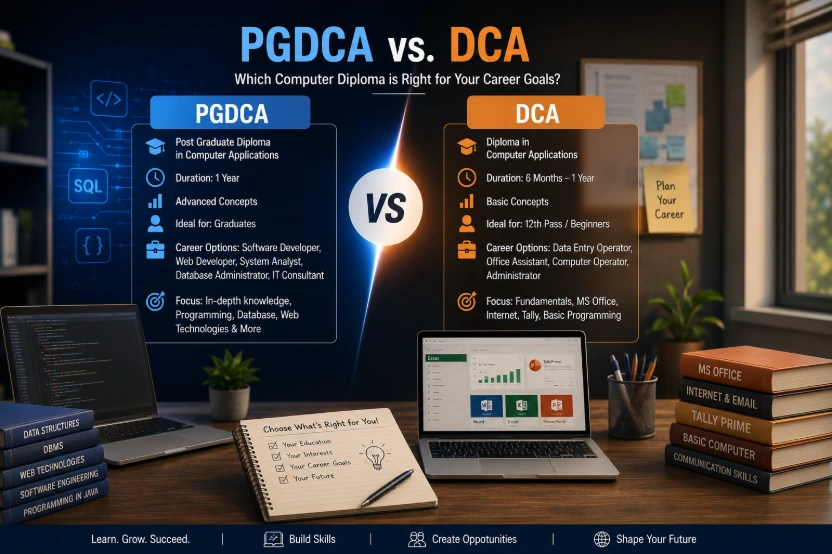
DCA: Open after 10th/12th | Short-term duration | Focuses on basic computer skills and MS Office tools | Prepares you for entry-level roles like Office Administrator, Data Entry Operator, or Receptionist.
PGDCA: Requires a college degree | Comprehensive professional duration | Focuses on advanced applications, web basics, and databases | Prepares you for advanced roles like IT Support Specialist, System Administrator, or Technical Assistant.
How to Choose the Right Path for You
To decide which track fits your career plan, look at your current educational background and immediate job requirements:
Choose DCA if: You want to quickly acquire practical computer skills to handle daily office operations, build retail invoices, manage databases using Excel, or apply for state government clerical roles that require basic computer certification.
Choose PGDCA if: You already hold a college degree and want an industry-recognized professional qualification to transition into banking, corporate management, IT logistics, or specialized software administration paths.
Get Certified and Job-Ready with Zen Institute
No matter which path fits your current goals, corporate employers prioritize your actual, hands-on ability to use software tools over simple textbook memorization.
At Zen Institute Mangalore, we provide both online and classroom training for these essential programs. Our industry-recognized DCA and PGDCA Courses are designed to give you practical, project-based skills that matter in the real world. Taught by expert mentors, you will move beyond basic definitions to manage real-world business scenarios.
Every student receives a recognized completion certificate to boost their resume, alongside dedicated job placement support—including resume building, interview practice, and direct referrals to hiring companies.
Stop second-guessing your technical qualifications. Build the verified computer skills that modern businesses require.
Frequently Asked Questions (FAQs)
1. What is the difference between DCA and PGDCA?
DCA (Diploma in Computer Applications) is a foundational computer course for students after 10th or 12th, while PGDCA (Post Graduate Diploma in Computer Applications) is an advanced program designed for graduates who want to build professional IT and computer application skills.
2. Who is eligible for a PGDCA course?
Anyone with a recognized bachelor's degree in any stream, such as B.Com, B.Sc, B.A., BBA, or BBM, can typically apply for a PGDCA course, subject to the institute's admission requirements.
3. Is DCA a good course after 12th?
Yes. DCA is a popular choice for students who want to develop practical computer skills, improve digital proficiency, and prepare for entry-level office, administrative, and computer-related roles.
4. Which course offers better career opportunities: DCA or PGDCA?
The right choice depends on your educational background and career goals. DCA is ideal for beginners seeking foundational computer skills, while PGDCA is better suited for graduates looking to pursue advanced IT, administrative, or technical roles.
5. Can I get a job after completing a DCA or PGDCA course?
Yes. Depending on your skills and experience, these qualifications can help you pursue opportunities in office administration, data entry, IT support, computer operations, customer service, and other computer-based roles.