
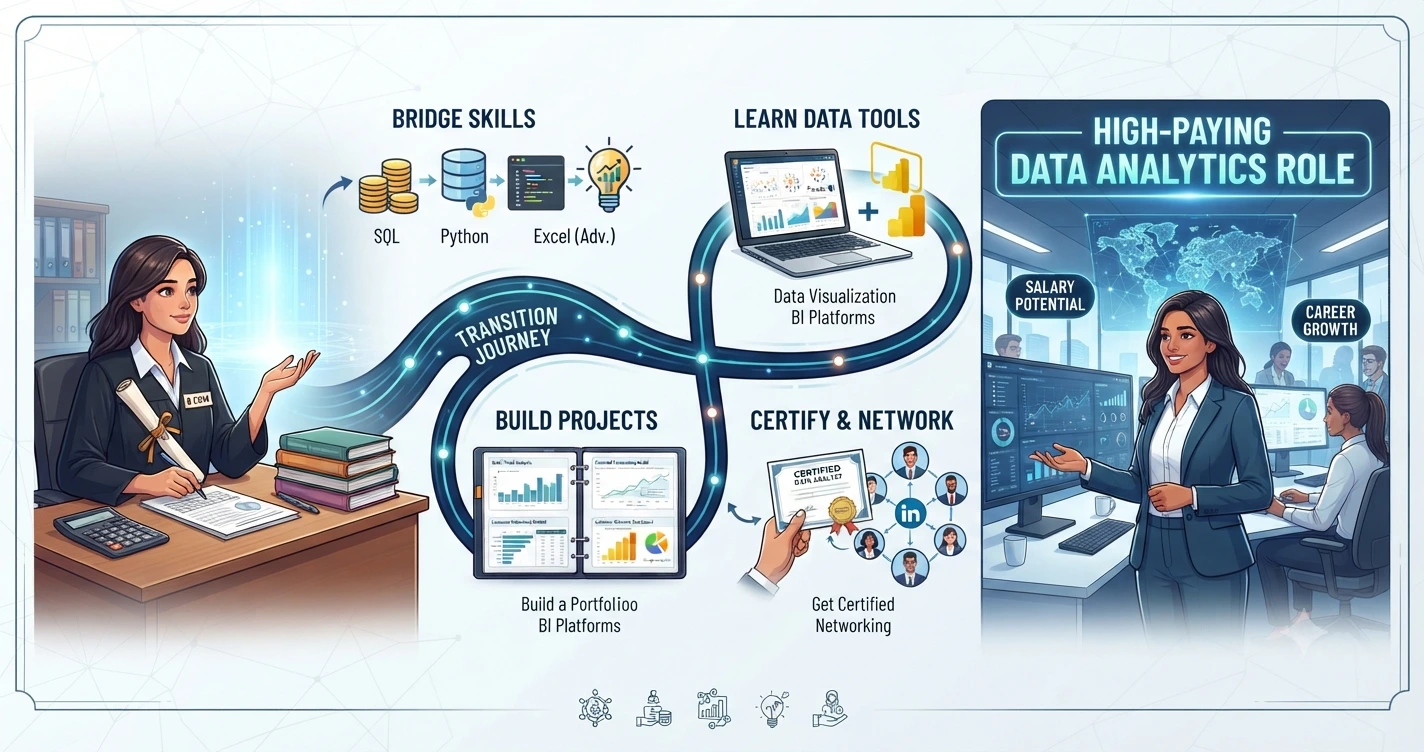
If you are pursuing or have recently completed a B.Com (Bachelor of Commerce) degree in Mangalore, you are likely familiar with the traditional career routes. For years, the standard advice has been to prepare for accounting profiles, join an audit firm, or study for banking exams.
While these remain stable paths, they are incredibly crowded, and starting salaries for entry-level accounting roles have struggled to keep pace with inflation. Meanwhile, a massive shift is occurring right next door in the technology sector. Modern corporate firms are actively recruiting for analytical roles, with Data Analysts commanding some of the highest entry-level packages in the current job market.
The best part? You do not need an engineering degree or a computer science background to make this transition. B.Com graduates actually possess a major, hidden advantage that makes them excellent data professionals.
Let's look at why your commerce background is valuable in data analytics and the step-by-step roadmap to make the transition successfully.
The Commerce Advantage: "Business Sense"
Many engineering graduates understand how to write code, but they often struggle to understand why they are writing it. They might build a flawless database query but fail to see how that data impacts a company's profit margin, inventory cost, or customer acquisition strategy.
This is where your B.Com training gives you an edge:
You Speak the Language of Business: You already understand balance sheets, revenue cycles, profit and loss statements, and market demand.
You Understand Corporate KPIs: Concepts like overhead costs, return on investment (ROI), and asset turnover are second nature to you.
You Contextualize Numbers: When you look at a spreadsheet, you don't just see random digits—you see business operations, sales performance, and financial health.
Data analytics is not just about writing code; it is about solving business problems using data. Your commerce background provides the business logic; you simply need to overlay it with modern digital tools.
The Step-by-Step Transition Roadmap
To successfully pivot into data analytics, you need to build a targeted, practical toolset. Focus on mastering these core technologies in sequence:
Step 1: Advanced Excel — Do not overlook this tool. Excel is the gateway to data analytics. You must move past basic tables to master complex formulas, Pivot Tables, VLOOKUP/XLOOKUP, and interactive data visualization models.
Step 2: SQL (Structured Query Language) — Modern corporate data does not live in simple spreadsheets; it is stored in massive databases. Learning SQL allows you to directly communicate with these databases to extract and filter the exact data you need.
Step 3: Power BI or Tableau — Once you extract data, you need to present it to management. These Business Intelligence (BI) tools allow you to turn boring rows of data into stunning, interactive visual dashboards that tell a story at a glance.
Step 4: Foundational Python — To future-proof your career, learn basic Python. It is a highly readable programming language used to automate repetitive data cleaning tasks and perform complex statistical analysis.
How to Present Your Profile to Tech Recruiters
When transitioning fields, your portfolio becomes your resume. Since you do not have a traditional computer science degree, you must prove your capabilities through tangible, real-world projects.
Instead of generic academic projects, design case studies that combine your financial knowledge with your new technical skills. For example:
A Sales & Revenue Dashboard: Use Power BI to analyze a retail company's quarterly sales data, highlighting exactly which products are most profitable and which regions are underperforming.
An Inventory Optimization Model: Use SQL and Excel to track warehouse stock levels, identifying slow-moving inventory that is tying up corporate cash flow.
When a hiring manager sees that you can merge deep business logic with modern data tools, your major or degree becomes secondary to your actual capabilities.
Kickstart Your Transition with Zen Institute
Trying to learn complex databases and visualization software through random, disconnected online tutorials can quickly lead to frustration. Without structured guidance, it is difficult to know if your projects meet real-world industry standards.
At Zen Institute Mangalore, our comprehensive Data Analytics Course is built specifically to help non-technical graduates transition into high-paying tech careers.
Taught entirely by elite mentors currently working at top multinational companies (MNCs), our curriculum focuses on hands-on, project-based learning. You will master Excel, SQL, Power BI, and Python by working on live corporate datasets and building a professional project portfolio.
Alongside your industry-recognized certification, every student receives dedicated career support—including professional resume development, mock technical interviews, and direct placement assistance with our extensive corporate hiring network.
Stop limiting your career options to traditional paths. Leverage your business background, build in-demand technical skills, and secure your place in a growing data economy.
Frequently Asked Questions (FAQs)
1. Can a B.Com graduate become a Data Analyst?
Yes. B.Com graduates can build a successful career in Data Analytics by learning tools such as Advanced Excel, SQL, Power BI, and Python. A strong understanding of business and finance can be an advantage when analyzing data.
2. Do I need a programming background to learn Data Analytics?
No. You can start with beginner-friendly tools like Excel and SQL before learning Python. Many Data Analytics courses are designed for students and professionals from non-technical backgrounds.
3. Which skills should a B.Com student learn for Data Analytics?
The key skills include Advanced Excel, SQL, Power BI or Tableau, Python, data visualization, and basic statistics. These skills are widely used by Data Analysts across industries.
4. What career opportunities are available after learning Data Analytics?
After gaining Data Analytics skills, you can apply for roles such as Data Analyst, Business Analyst, Financial Analyst, Business Intelligence (BI) Analyst, Reporting Analyst, and Data Associate.
5. Is Data Analytics a good career option for commerce students?
Yes. Data Analytics combines business knowledge with technical skills, making it an excellent career option for commerce graduates looking for high-growth opportunities across finance, retail, healthcare, banking, and technology sectors.