
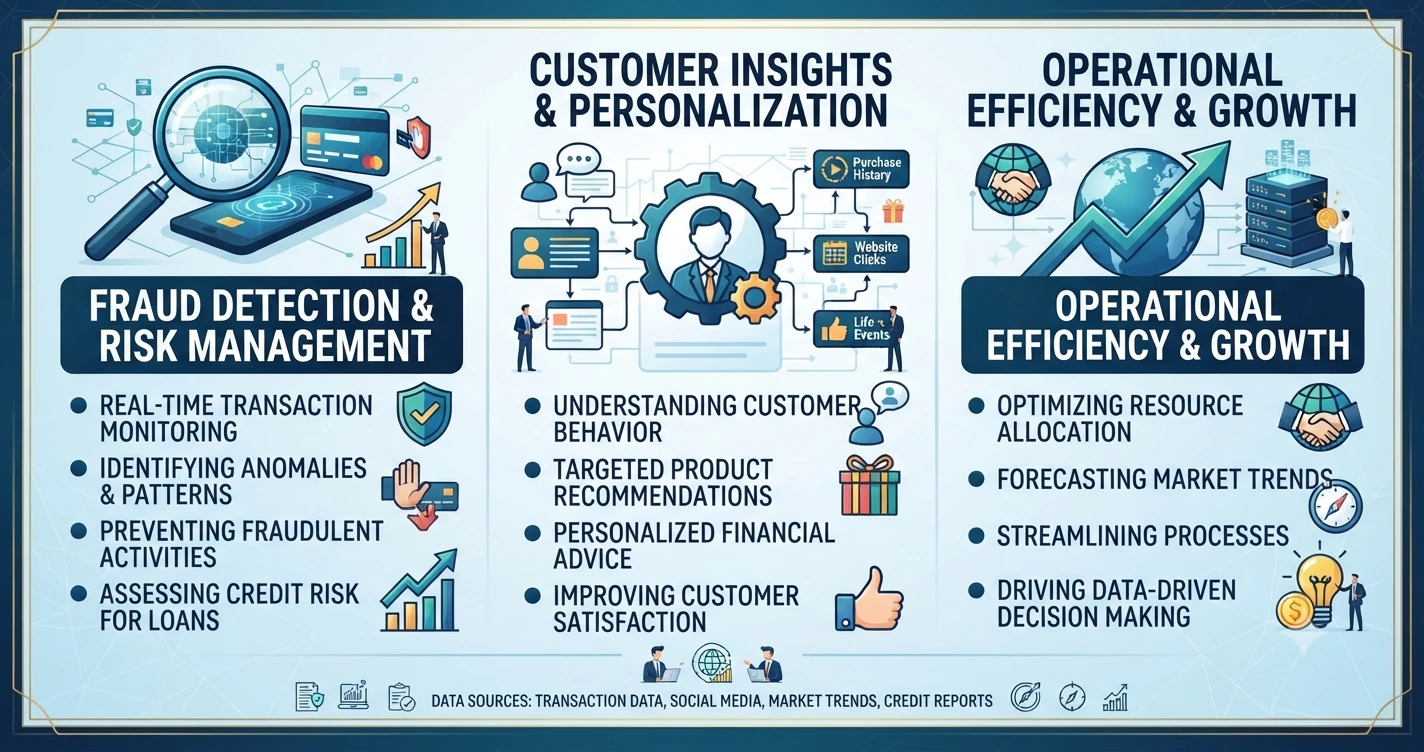
The banking and financial services sector across India—from the historic banking hubs of Mangalore and coastal Karnataka to the major economic centers of Mumbai and Bangalore—has always run on risk management. Historically, financial institutions assessed risk by looking backward, manually auditing spreadsheets of past transactions, historical credit files, and year-old balance sheets.
In today's fast-moving market, looking backward isn't enough. Modern banks, fintech startups, and investment houses operate using Predictive Analytics.
By processing massive streams of live financial data using advanced data science, machine learning models can accurately forecast future customer behavior, identify systemic risks, and detect security threats before they occur. Let's look into how data analytics is revolutionizing modern finance.
1. Automated Credit Scoring and Underwriting
Traditional banking loan approvals were notoriously slow, bureaucratic, and prone to human error. Loan officers evaluated applicants based on rigid, limited data points like basic monthly salary slabs and historical credit scores.
Predictive models allow banks to implement automated underwriting systems that evaluate creditworthiness in seconds by analyzing a broader array of variables:
Real-time transaction patterns and cash-flow consistency.
Regional economic trends and sector-specific business stability.
Alternative data, including utility bill payment history and digital wallet activity.
By assessing thousands of hidden data correlations instantly, predictive models help financial institutions safely approve loans for credit-worthy individuals who lack a traditional banking footprint, while identifying high-risk borrowers who might otherwise skip through regular checks.
2. Real-Time Fraud Detection and Prevention
Financial fraud has become highly sophisticated, with bad actors using automated bots and identity spoofing to bypass basic login protocols. Traditional rule-based security systems only flag a transaction after a breach has occurred based on a few basic parameters.
Predictive analytics tools run advanced anomaly detection algorithms that evaluate every single swipe, transfer, and login attempt in real-time ($<100\text{ milliseconds}$).
The model establishes a unique behavioral baseline for every customer—analyzing typing speed, device fingerprints, standard geographical radii, and historical spending velocity. If a customer who typically buys groceries in Mangalore suddenly purchases high-end electronics in a foreign country via an unrecognized device, the predictive engine flags the transaction as an anomaly and halts the payment before the funds leave the account.
3. Algorithmic Trading and Market Forecasting
In investment banking and wealth management, predictive analytics serves as the engine behind high-frequency algorithmic trading systems.
Instead of relying on human brokers to read news feeds and execute trades, mathematical models ingest structured and unstructured data streams simultaneously—including historical price trends, corporate earnings filings, global economic indicators, and real-time news sentiments. The system processes these indicators to identify subtle market patterns, executing high-volume trades at the optimal microsecond to maximize investment returns.
4. Personalizing Financial Planning and Reducing Churn
Customer retention is highly competitive in the banking and fintech space. Predictive analytics allows institutions to anticipate customer needs and offer hyper-personalized financial advisory services.
By studying transactional habits, a predictive model can identify major life milestones, such as when an account holder is likely looking to buy a home, invest in mutual funds, or secure business capital. This allows banks to target the right financial product to the right user at the exact moment they need it, drastically increasing conversion rates while proactively addressing customer dissatisfaction to lower churn.
Launch Your Data Career with Zen Institute
The banking, financial, and fintech sectors are currently among the largest employers of data professionals globally. As financial institutions continue to invest heavily in automated systems, the demand for certified data experts who understand predictive modeling is outstripping supply.
At Zen Institute Mangalore, our comprehensive AI and Machine Learning Course provides the deep technical training required to excel in data-driven sectors like modern finance.
Led step-by-step by elite corporate mentors currently working at top global MNCs, our practical curriculum guides you through building machine learning pipelines, writing advanced Python algorithms, managing SQL databases, and working on authentic corporate data analytics challenges.
Alongside your industry-recognized certification, every student receives complete, dedicated career assistance—including portfolio design, professional resume building, mock technical interviews, and direct placement referrals to our extensive network of local and national corporate hiring partners.
Frequently Asked Questions (FAQs)
1. What is predictive analytics in banking and finance?
Predictive analytics uses data, machine learning, and statistical models to analyze historical and real-time information, helping banks forecast customer behavior, assess risks, and make informed financial decisions.
2. How does predictive analytics improve fraud detection?
Predictive analytics monitors transactions in real time, identifies unusual spending patterns, device activity, and login behavior, enabling banks to detect and prevent fraudulent transactions before they are completed.
3. How is predictive analytics used in loan approvals?
Banks use predictive analytics to evaluate creditworthiness by analyzing transaction history, cash flow, payment behavior, and other financial data, making loan approval faster and more accurate.
4. How does predictive analytics help banks improve customer experience?
By analyzing customer behavior and financial goals, predictive analytics enables banks to offer personalized products, financial advice, and timely recommendations while reducing customer churn.
5. How can Zen Institute help you build a career in AI and predictive analytics?
Zen Institute's AI and Machine Learning Course provides hands-on training in Python, machine learning, SQL, and predictive analytics, along with certification, real-world projects, resume building, mock interviews, and placement support.