
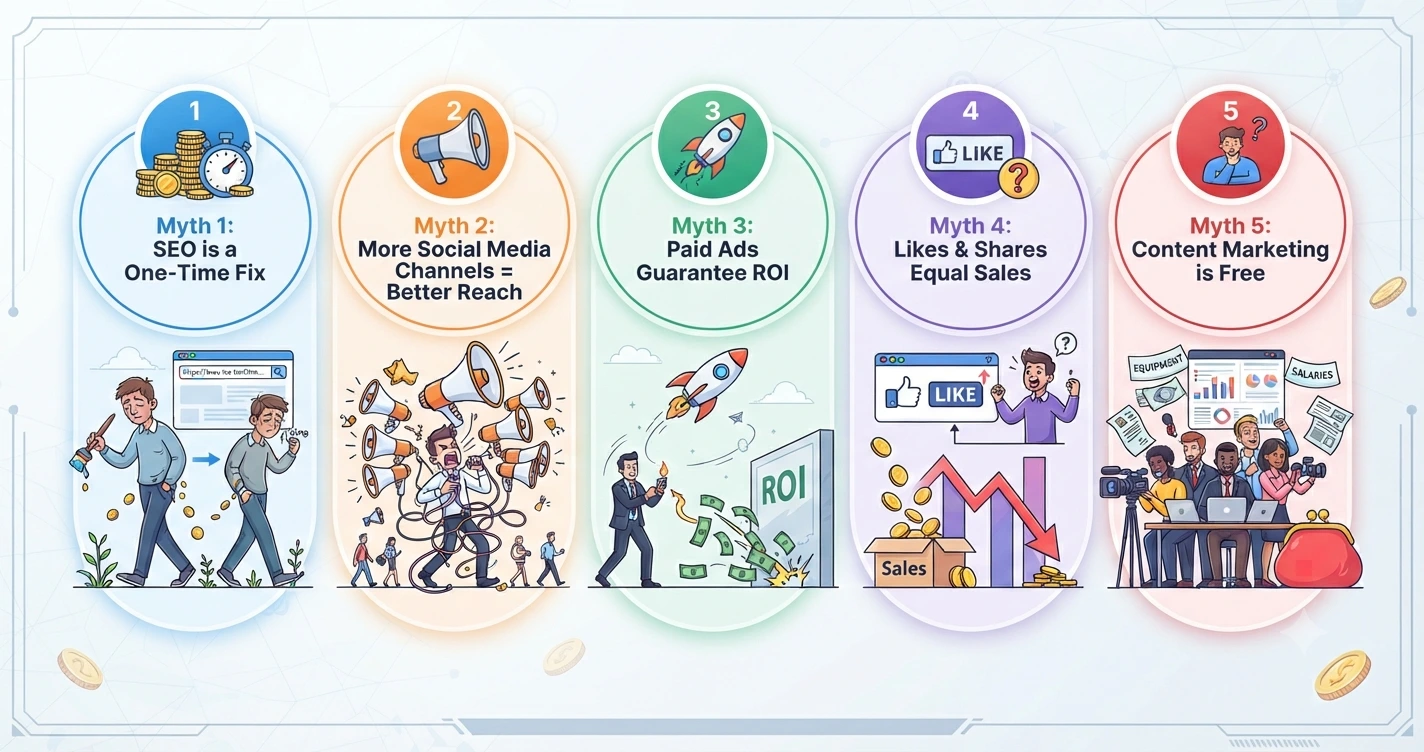
Walk into any business meeting across Mangalore—whether it’s a retail storefront in Hampankatta, a corporate consultancy in Balmatta, or a new café opening near Kankanady—and you will find that business owners agree on one thing: they need an online presence to grow. However, because digital marketing has evolved so quickly, it has become surrounded by a massive wave of misinformation. Many local business owners and aspiring professionals rely on outdated advice, viral trends, or incorrect assumptions to make major financial decisions.
Believing these misconceptions doesn't just stall your growth—it directly wastes your advertising budget on strategies that yield no real return on investment.
Let’s dismantle five of the most common digital marketing myths that are costing you money and look at the actual strategies that drive revenue.
Myth 1: "Digital Marketing is Just Posting Consistently on Social Media"
The Myth: Many businesses believe that if they upload an image or a short video to Instagram and Facebook every single day, their sales will automatically skyrocket.
The Reality: Posting generic content consistently without a targeted conversion strategy only builds what marketers call "vanity metrics" (likes and views), not actual sales. Social media algorithms limit how many of your followers see your organic posts.
The Fix: To get a real return on your time, you must combine your organic posts with a structured funnel. This means running targeted paid advertising campaigns, optimizing your website to capture consumer details, and building local SEO (Search Engine Optimization) visibility so you show up when someone searches for your service on Google.
Myth 2: "SEO Takes Too Long; Paid Ads Are All We Need"
The Myth: Because SEO takes a few months to show significant ranking shifts, many businesses skip search optimization entirely and pour their entire budget into running paid ads for instant traffic.
The Reality: Paid advertising is an excellent tool, but it is a short-term tap. The moment you stop spending money on Google or Meta Ads, your traffic drops to zero instantly. Furthermore, ad costs increase every year as more competitors enter the local Mangalore market.
The Fix: Think of paid ads as renting traffic, while SEO is like owning a digital asset. Investing in a robust local SEO strategy means your website builds long-term authority, keeping you at the top of Google search results for months or years without paying for every single click.
Myth 3: "More Traffic Automatically Means More Sales"
The Myth: A common benchmark for website success is simply looking at the total number of monthly visitors. Many agencies brag about bringing "10,000 new clicks" to a website.
The Reality: Traffic is useless if it is the wrong type of traffic or if your website is poorly designed. If a local luxury real estate developer targets an ad broad enough to bring thousands of casual students to their site, they won't make a single sale.
The Fix: Focus on high-intent, targeted traffic over raw volume. A professional digital marketer analyzes user behavior, refines target demographics, and ensures the landing page uses persuasive UI/UX Design principles to turn casual website visitors into paying leads.
Myth 4: "My Business is B2B, So Instagram and Meta Ads Won't Work"
The Myth: Traditional Business-to-Business (B2B) companies, such as manufacturing units in Baikampady or wholesale suppliers, often assume that digital ads only work for retail, fashion, or food brands.
The Reality: Corporate decision-makers, purchase managers, and CEOs do not cease to be human consumers when they leave the office. They scroll through Instagram, watch YouTube videos, and browse Facebook just like everyone else.
The Fix: A B2B marketing strategy simply uses a different content angle. Instead of using flashy product sales, you use professional retargeting ads, educational video case studies, and corporate thought-leadership pieces to build brand authority in front of business owners while they are online.
Myth 5: "Digital Marketing is an Expense, Not an Investment"
The Myth: When cash flow gets tight, marketing is often the very first budget item that business owners cut, viewing it as an optional luxury expense.
The Reality: Cutting your marketing budget during a slow business cycle is like stopping your watch to save time. True digital marketing is entirely trackable. Unlike a traditional billboard where you guess how many people saw it, a digital campaign tells you exactly how many rupees you spent and exactly how much revenue those clicks generated.
The Fix: Shift your perspective from view counts to attribution tracking. When you set up proper analytics, your marketing becomes a predictable customer-generation engine.
Master Data-Driven Marketing with Zen Institute
The digital industry moves fast, and strategies that worked a few years ago are no longer effective today. For aspiring professionals and local business owners, trying to learn marketing through random, unverified online videos often leads to costly mistakes.
At Zen Institute Mangalore, our comprehensive Digital Marketing Course moves past outdated theories to focus entirely on live, data-driven execution.
Taught by elite corporate mentors who manage large budgets for top MNCs, our program guides you through the exact tools the industry uses today. You will manage live ad campaigns, practice advanced search optimization, build working funnels, and analyze real web traffic.
Alongside your industry-recognized certification, every student receives complete career and placement support—including resume development, portfolio building, and direct interview prep to launch your career in a high-demand tech sector.
Stop guessing with your digital strategy. Learn the data-backed skills that lower customer acquisition costs and drive sustainable business growth.
Frequently Asked Questions (FAQs)
1. Is digital marketing suitable for small and local businesses?
Yes. Digital marketing helps small and local businesses increase online visibility, reach nearby customers, generate qualified leads, and compete effectively with larger brands using cost-effective strategies.
2. What is the difference between SEO and paid advertising?
SEO focuses on improving your website's visibility in organic search results for long-term traffic, while paid advertising generates immediate visibility through platforms like Google Ads and Meta Ads. Many businesses benefit from using both strategies together.
3. How can I measure the success of a digital marketing campaign?
Key performance indicators (KPIs) such as website traffic, lead generation, conversion rate, return on ad spend (ROAS), click-through rate (CTR), and customer acquisition cost (CAC) help measure campaign performance.
4. Can I learn digital marketing without prior experience?
Yes. Digital marketing is beginner-friendly and can be learned through structured training, practical projects, and hands-on experience with tools such as Google Analytics, Google Ads, and SEO platforms.
5. What career opportunities are available after learning digital marketing?
Digital marketing skills can lead to careers such as SEO Executive, Digital Marketing Executive, Social Media Manager, Performance Marketer, PPC Specialist, Content Marketer, and Digital Marketing Analyst.